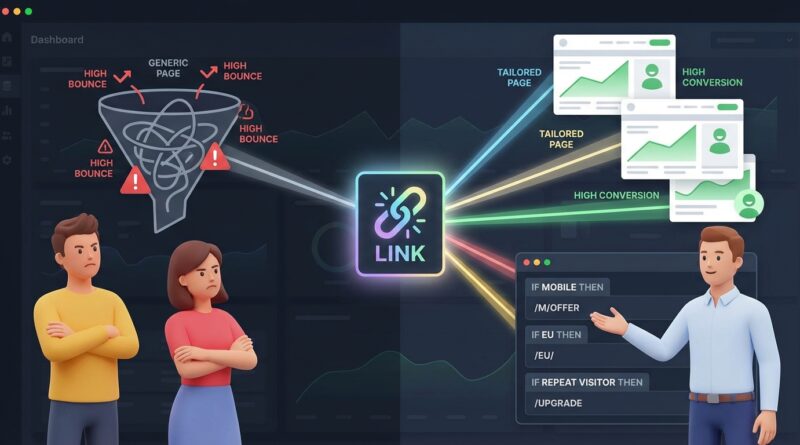
Stop Sending Every Click To The Same Page: How To Use Smart Link Routing To Rescue ‘Good’ Traffic From Bad Landing Pages
You can do everything “right” in a campaign and still lose the sale in the last two seconds. That is the maddening part. The ad gets the click. The email gets opened. The QR code gets scanned. Then everyone gets dumped onto the same landing page, no matter whether they are on a phone, in Germany, coming from SMS, or already halfway to buying. If that sounds familiar, you are not dealing with a traffic problem as much as a routing problem. Smart link routing with url shortener tools fixes that last-mile mistake by sending different visitors to the page that actually fits them. It is not fancy for the sake of it. It is basic common sense applied at the link level. And because it sits between the click and the page, it is often much faster to set up than rebuilding your site or begging for dev time.
⚡ In a Hurry? Key Takeaways
- Smart link routing with url shortener tools sends people to the best page for their device, location, source, or intent instead of one generic URL.
- Start with simple rules first. Route mobile traffic to faster pages, EU visitors to compliant versions, and warm traffic to deeper-funnel offers.
- Keep tracking intact while you test. If platforms keep stripping or rewriting your links, fix that first so your routing data stays useful.
Why the “one link for everyone” habit wastes good traffic
Marketers often blame the ad, the copy, or the audience when conversion rates dip. Sometimes those things are the problem. But often the click was fine. The page match was not.
Think of it like sending every customer in a store to the same aisle. Someone looking for a quick checkout gets sent to a long product explainer. Someone on a shaky mobile connection gets a giant desktop page full of scripts and pop-ups. A visitor from a country with different legal requirements lands on the wrong version entirely.
Of course bounce rates climb.
This is where smart link routing with url shortener setups earns its keep. Instead of sharing five different URLs and hoping your team uses the right one each time, you use one smart link that makes a quick decision based on the visitor.
What smart link routing actually means
At its simplest, smart routing means your short link checks a few facts about the click and then forwards the visitor to the most suitable destination.
Those routing rules can include:
- Device type, like mobile vs desktop
- Operating system, like iPhone vs Android
- Location, such as US vs EU
- Traffic source, like email vs paid social
- Time or campaign window
- Repeat clicks vs first-time clicks
That sounds technical, but the idea is not. If someone taps from an email they already trusted enough to open, they should not always see the same page as a cold social clicker. Their needs are different. So should the destination be.
Where smart routing makes the fastest difference
1. Mobile users need lighter pages
A lot of landing pages still look like they were built for a giant monitor and a stable office connection. Then a paid social user hits that page from a phone on 4G and waits. And waits.
A smart link can send mobile users to a stripped-down page with faster load times, cleaner forms, and fewer distractions. Desktop users can still get the fuller version if that makes sense.
This one change alone can rescue clicks that were never “bad.” They were just forced into the wrong experience.
2. Regional visitors need the right version
If you operate across countries, routing matters even more. Pricing, language, availability, and privacy notices can vary by region. Sending EU traffic to a page built for US visitors is sloppy at best and risky at worst.
Smart routing lets one link send visitors to region-specific pages without making your campaigns messy. It also helps keep reporting cleaner because your team can promote one smart URL while the logic happens behind the scenes.
3. Warm traffic should not start at the beginning
A repeat email clicker is not a stranger. Someone who scanned a QR code on your packaging is not at the same awareness stage as a random ad click. Yet many campaigns still send both to the same hero page with the same generic message.
That is like greeting a returning customer with, “Welcome, here is what we sell,” instead of, “Good to see you again, ready to check out?”
Use routing to send warmer audiences to pricing, booking, demos, product collections, or faster checkout paths.
4. Different channels carry different intent
SMS clicks tend to be quick and urgent. Email clicks often come from people who already know your brand. Paid social can be more exploratory. QR code scans might happen in a shop, at an event, or on printed packaging.
One destination page rarely serves all those moments equally well.
A smart link routing with url shortener setup lets you keep distribution simple while respecting the different intent behind each source.
How to set it up without turning it into a giant project
The good news is you do not need to rebuild your entire funnel. Start with one smart link and a few obvious rules.
Pick a high-traffic link first
Choose a link that already gets meaningful volume across more than one channel or audience segment. A homepage promo link, a campaign CTA, or a product link shared in email, ads, and social is a good candidate.
Create only 2 to 4 destinations at first
Do not begin with twenty branches. That gets confusing fast.
Start with something like:
- Mobile users go to a lightweight landing page
- Desktop users go to the full page
- EU users go to the compliant regional version
- Email traffic goes to a warmer, deeper-funnel page
Use plain rules you can explain in one sentence
If your team cannot explain the routing logic clearly, it is too complicated. A good first rule sounds like this: “Anyone from email goes to the offer page, everyone else goes to the explainer page.”
Simple beats clever.
Keep your tracking clean
This part matters. If platforms strip parameters or rewrite your URLs, your nice routing setup can get harder to measure. If that has been happening to you, read Stop Letting Platforms Rewrite Your Links: How To Keep Your Tracking When Big Tech ‘Cleans Up’ Your URLs. It is a useful reminder that link control and tracking control go together.
Common mistakes people make with smart routing
Sending people somewhere “different” but not better
Different is not the goal. Better is. If your mobile page is just a trimmed-down mess, routing will not save it. Each destination still needs to fit the user’s moment.
Over-segmenting too soon
Not every click needs a custom experience. If you create too many rules too early, you can end up with tiny traffic buckets and fuzzy results. Focus on the biggest mismatches first.
Ignoring page speed
Routing can improve page fit, but it cannot rescue a painfully slow page forever. If your short link sends people to a page that still takes ages to load, you have just moved the problem.
Forgetting fallback behavior
Always decide what should happen if location is unclear, the device cannot be identified, or a rule conflicts with another rule. A clean fallback URL prevents weird dead ends.
What results should you expect?
Usually not magic. Usually something better than magic. A practical lift.
When routing is done well, you often see:
- Lower bounce rates
- Better mobile conversion rates
- More accurate regional experiences
- Higher click-to-checkout progression for warm audiences
- Less wasted ad spend on misrouted traffic
And because this sits at the link level, you can often start testing it in an afternoon. That makes it one of the rare marketing fixes that is both useful and fast.
Who should care most about this?
Honestly, almost any team sharing links across multiple channels.
But it is especially helpful if you:
- Run paid campaigns to mixed devices
- Market across countries or regions
- Share the same link in email, SMS, social, and QR codes
- Have separate pages for education, offers, and checkout
- Want quicker wins without waiting on a full site rebuild
If that sounds like your day-to-day, smart link routing with url shortener tools is not some niche trick. It is basic traffic hygiene.
At a Glance: Comparison
| Feature/Aspect | Details | Verdict |
|---|---|---|
| Generic single URL | Every visitor lands on the same page, regardless of device, location, or traffic source. | Easy to manage, but often wastes strong clicks. |
| Smart routed short link | One shared link can send mobile, regional, or high-intent visitors to different pages automatically. | Best balance of simplicity, control, and performance. |
| Full site rebuild or funnel redesign | Can improve the whole experience, but usually takes more time, approvals, and dev work. | Useful later, but not the fastest fix for last-mile mismatch. |
Conclusion
When good traffic lands on the wrong page, it looks like a traffic quality problem even when it is really a routing problem. That is why this matters right now. Performance teams are burning budget on visitors who might convert if they simply reached a page that fit their device, region, or intent. With ad costs climbing and attribution getting murkier, one of the fastest wins is not a shiny new platform. It is fixing the short stretch between click and content. Smart routing at the link level can send mobile users to lighter pages, direct EU visitors to compliant versions, move repeat clickers toward deeper offers, and give warm audiences a faster path to checkout. It is practical, quick to test, and useful across ads, email, SMS, QR codes, and social. In other words, it helps you get more value from the traffic you already worked hard to earn.