Stop Letting Your Short Links Lose Context: How To Build ‘Human‑Readable’ Short URLs That Still Track Perfectly
You can feel this happening in real time. Someone sees your link, pauses, long-presses, maybe even squints at it, then decides not to tap. That is frustrating, especially when your campaign is fine, your landing page is fine, and your analytics setup is fine. The problem is the link looks like a mystery. A random slug on a generic shortener now feels less like convenience and more like risk. People have been trained by phishing scams, sketchy redirects, and cluttered link shorteners to be careful. Fair enough.
The good news is you do not have to choose between trust and tracking. You can build short links that still look clean, still fit in social posts, email, SMS, and print, but also tell people where they are headed before they click. That means using plain-language slugs, branded domains, sensible redirect rules, and tracking that stays behind the scenes instead of making the URL look suspicious. If you want practical human readable short urls best practices, this is where to start.
⚡ In a Hurry? Key Takeaways
- Use branded short domains and plain-language slugs so people can predict the destination before they click.
- Keep tracking in redirects or analytics settings, not in ugly visible strings that make links look sketchy.
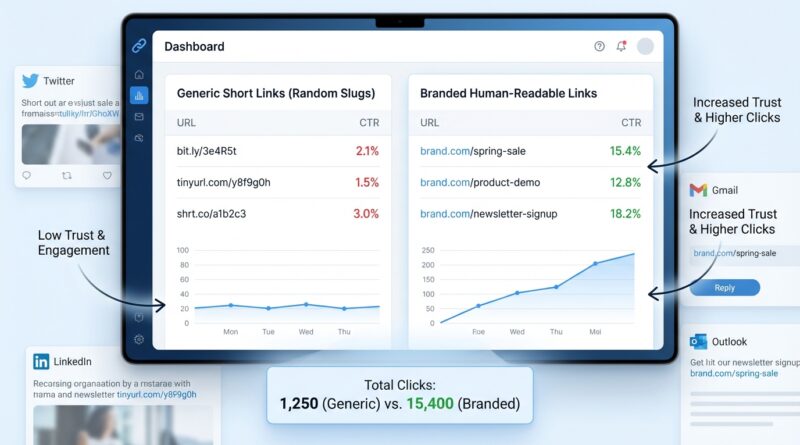
- Readable links improve trust, and trust now has a direct effect on click-through rates.
Why mystery links are starting to fail
Short links used to be judged on one thing. Were they short enough to fit?
Now people judge them on something else first. Do they feel safe?
That is a big shift. A link like bit.ly/7xQ2Lm or go.something.com/a9Kp3 technically works, but it tells your audience nothing. Is it a pricing page? An event registration page? A coupon? A login screen? People cannot tell, so they hesitate.
That hesitation matters. Every extra second of doubt is a small drop in clicks.
It gets worse in SMS, WhatsApp, QR codes, and social bios, where people often have less context and are already on alert for scams. If the link looks vague, it feels vague.
What “human-readable” really means
A human-readable short URL is exactly what it sounds like. It is short enough to share, but clear enough for a normal person to understand.
Good example
brand.co/summer-sale
Bad example
brand.co/x7P9qL
Both can point to the same page. Both can track clicks. But only one gives the reader confidence.
The best human readable short urls best practices are not about making links longer. They are about making the visible part of the link do a little useful work.
The simple formula for readable short links
You do not need a giant rebuild. Most teams can improve this with a simple pattern:
1. Use a branded short domain
If possible, use your own short domain or subdomain. Something like go.yourbrand.com, try.yourbrand.com, or a short custom domain you own.
This solves the first trust problem. People can see the link belongs to you.
2. Use plain-language slugs
Your slug is the part after the slash. Make it readable.
Examples:
- /pricing
- /demo
- /webinar
- /spring-offer
- /refer-a-friend
Avoid random strings unless there is a true security reason.
3. Keep it short, but not cryptic
You are aiming for “instantly understood,” not “fewest possible characters.”
/book-demo is better than /bd.
/new-menu is better than /nm24.
If a first-time visitor can guess where the link goes, you are on the right track.
4. Put tracking behind the curtain
You still need campaign data. Of course you do.
But the tracking does not have to make the public-facing link ugly. Use redirect-level analytics, hidden UTM handling, or platform analytics that preserve attribution without turning the link into a wall of parameters.
The public URL should look calm. The measurement can happen in the background.
Slug patterns that work well in the real world
If your team freezes every time someone asks, “What should we name this link?”, a pattern library helps. Make a few slug formats and stick to them.
For promotions
- /summer-sale
- /20-off
- /free-shipping
For events
- /webinar
- /march-webinar
- /event-rsvp
For product pages
- /new-arrivals
- /gift-cards
- /pro-plan
For support and trust
- /help
- /returns
- /track-order
For print and QR campaigns
- /menu
- /apply
- /open-house
Notice the pattern. These are not clever. That is the point. Clear beats clever almost every time.
What to avoid
Random slugs by default
If your shortener creates random codes automatically, that may be convenient for the system but not for your audience.
Too much campaign jargon
Your internal naming system is not helpful to customers. /q3-abm-retargeting-a means something to the marketing team, but not to a person on a phone.
Date clutter
Dates can be useful, but only when they add clarity. /holiday-2025 can work. /offer-031725-v2 usually does not.
Visible UTM mess
If the visible URL includes a long string of tracking parameters, it looks messy and suspicious. Keep the front clean.
Tracking without wrecking trust
This is where marketers get nervous, and I get it. If you clean up the link too much, will analytics break?
Not if you set things up properly.
Use 301 or 302 redirects intentionally
For most campaigns, a standard redirect from your readable short URL to the final landing page works fine. Your analytics platform can still capture the visit, and your campaign tools can still attribute traffic.
Store campaign data in the redirect platform
A good redirect setup should log click counts, time, device, referrer, location, and destination without forcing all that information into the visible URL.
Use UTMs when needed, but generate them cleanly
If your destination page needs UTMs, attach them at the redirect level so the public link stays simple. That means users see go.brand.com/demo, while your system quietly sends them to the full tracked destination.
Keep one readable link per audience intent
If you need channel-level tracking, create separate readable links instead of one ugly all-purpose link.
For example:
- brand.co/demo-email
- brand.co/demo-sms
- brand.co/demo-qr
That is often easier to manage and easier to explain later in reporting.
Readable links matter even more for QR codes
QR codes have a trust problem too. People scan first and ask questions later, which is exactly why they are more cautious now.
If your QR code resolves to a readable, branded short URL, people are more likely to feel comfortable continuing. And if that destination ever changes, a managed redirect can save your campaign from becoming dead print.
That is where this related guide is worth your time: Stop Letting Your QR Codes Die: How To Build ‘Self‑Healing’ Short Links Before Link Rot Kills Your Campaigns. It pairs nicely with readable URL strategy because trust and durability usually need the same foundation.
A quick trust test for every short link
Before you publish a link, ask four simple questions:
- Can a normal person guess where this goes?
- Does the domain clearly belong to us?
- Does the slug use real words instead of random code?
- Can we still measure clicks and source cleanly?
If the answer is yes across the board, you are in good shape.
Best practices checklist you can use this week
Do this
- Use a branded short domain
- Write slugs with plain English words
- Match slug wording to user intent
- Keep links visually simple
- Track clicks in the redirect layer
- Create repeatable naming rules for your team
Skip this
- Random auto-generated slugs for customer-facing campaigns
- Generic shortener domains when brand trust matters
- Visible tracking strings in shared links
- Internal campaign abbreviations users will not understand
- One catch-all short link for every source and audience
At a Glance: Comparison
| Feature/Aspect | Details | Verdict |
|---|---|---|
| Readable slug | Uses plain words like /pricing or /summer-sale instead of random characters | Best for trust and better click confidence |
| Branded short domain | Shows your brand in the URL, which helps users feel safer before clicking | Strongly recommended for email, SMS, social, and QR use |
| Hidden tracking via redirects | Keeps analytics intact without exposing messy parameters in the public link | Best balance of measurement and clean presentation |
Conclusion
Short links still matter, but the rules have changed. A link is no longer just a compact pointer. It is a trust signal. When people hover, long-press, and inspect before clicking, the brands that make intent obvious have an edge. That is why human-readable short URLs are not just a nice extra. They are now part of good campaign hygiene. If you give your team a simple pattern for readable slugs, branded domains, and redirect-based tracking, you can send cleaner links across social, email, SMS, and print without breaking analytics or rebuilding your whole stack. That helps right now, because click-through is no longer just about how short a link is. It is about how safe and predictable it feels. And that is exactly where a calm, transparent tool like Redirect My can stand out from opaque black-box shorteners.