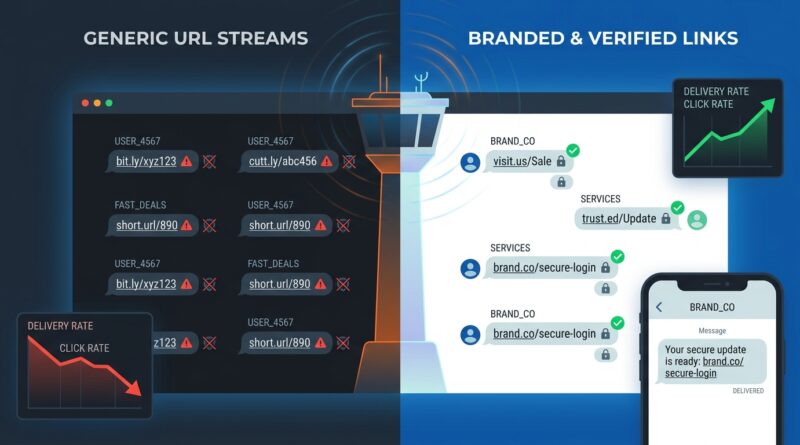
Stop Letting Your Short Links Kill SMS Deliverability: How To Build ‘Carrier-Friendly’ URLs That Still Track Clicks
You send a big SMS campaign, watch the dashboard, and something feels off almost immediately. Delivery slows down. Replies drop. Click numbers look weird. Then someone mentions the link. That little shortened URL you were told to use for “cleaner messages” may be the exact thing making carriers nervous. It is frustrating because you did not change the offer, the audience, or the timing. You changed the link, and suddenly deliverability falls apart.
The good news is this is fixable. Carriers and spam filters do not hate tracking. They hate patterns that look risky, especially shared short domains that bad actors also use. The safer play is simple: use a branded tracking domain, shorten selectively, keep links readable, and test before every large send. If you want the trust side of this problem too, our guide on Stop Letting Your Short Links Get You Phished: How To Build ‘Human‑Readable’ URLs People Actually Trust Enough To Click pairs nicely with the deliverability advice below.
⚡ In a Hurry? Key Takeaways
- For sms link shortening best practices for deliverability, avoid generic public shorteners in bulk campaigns and use your own branded tracking domain instead.
- Shorten only when you need to. Keep links readable, relevant to the message, and mapped to trusted pages with clean redirects.
- Test sends across major carriers before scaling, because a link that passes on one network can still get throttled or filtered on another.
Why short links suddenly hurt SMS and WhatsApp campaigns
On paper, short links make sense. They save space, look tidy, and make click tracking easy.
In the real world, shared shorteners have baggage. Carriers, mobile security tools, and messaging platforms know that spammers love throwaway short domains. If enough bad traffic comes from the same domain, that domain starts to carry risk. Your perfectly normal campaign can get caught in the same net.
That is why marketers using platforms like Iterable, Customer.io, and HighLevel are being nudged toward custom tracking domains. It is not cosmetic. It is a trust signal.
What carriers and filters are actually looking at
No carrier publishes a neat checklist, but the patterns are easy to spot.
Shared short domains
If your link uses a public shortener that thousands of strangers also use, your reputation is mixed in with theirs. That is not a great place to be.
Mismatch between message and destination
If the text says “confirm your appointment” but the link redirects through a generic short domain to a page that looks unrelated, filters can get jumpy.
Redirect chains
One redirect is normal. Three or four redirects in a row starts to look messy and risky.
Fresh or poorly configured domains
A brand new domain with no history, weak DNS setup, or inconsistent SSL can raise questions too.
Bulk sending patterns
A suspicious link in a one-off message may slip by. The same link blasted to thousands of contacts in minutes gets much more scrutiny.
The better approach: branded, carrier-friendly tracking URLs
If you want clean analytics without hurting deliverability, start with your own branded domain or subdomain for tracking.
Good examples look like this:
go.yourbrand.com/spring
links.yourbrand.com/demo
visit.yourbrand.com/renew
That works better than a random shared short domain because the link is tied to your brand. It is easier for people to trust, and easier for systems to classify as legitimate.
Which links to shorten and which to leave alone
This is where many teams overdo it. Not every message needs a tiny link.
Good candidates for shortening
Use shortened branded links when the original URL is long, stuffed with tracking parameters, or ugly enough to distract from the message.
Examples:
- Campaign links with UTM tags
- Event registration pages with long query strings
- Multi-step product URLs generated by ecommerce platforms
Links you may want to leave longer
If the destination is already clean and easy to read, shortening may not help much.
- Your homepage
- A simple booking page
- A support page with a short branded URL
If your natural URL is already understandable, keeping it visible can improve trust and may avoid one extra redirect.
How to pick the right branded domain
You do not need anything fancy. You need something trustworthy and clear.
Best option: use a subdomain of your main domain
This is usually the safest choice. It inherits some brand familiarity and keeps everything connected.
Examples:
- go.yourbrand.com
- txt.yourbrand.com
- link.yourbrand.com
Second-best option: a closely related standalone domain
If your main domain is awkward for tracking, use something short but obviously tied to your brand. Do not make it cryptic.
What to avoid
- Domains with odd spellings
- Cheap-looking abbreviations that feel unrelated to your brand
- A brand new domain used only for mass campaigns on day one
Basic setup checklist for a custom tracking domain
This is the part people skip, then wonder why results are uneven.
1. Set DNS correctly
Point the branded domain or subdomain where your sending platform requires. Follow their instructions exactly. One wrong DNS record can break tracking or create trust issues.
2. Make sure SSL works
Your tracking link should load securely over HTTPS. If a secure connection fails, that is a bad look for both users and filters.
3. Keep redirects clean
Go from message link to final destination in as few steps as possible. Fewer hops usually means less friction.
4. Match the destination to the message
If the text says “See your invoice,” land them on the invoice page. Not a generic homepage. Not a broad category page.
5. Warm it up before a huge blast
Do not set up a new tracking domain at 9 a.m. and send 500,000 messages at noon. Start with smaller sends first so networks and security systems see normal behavior.
How to still track clicks without making links look suspicious
You do not have to choose between analytics and deliverability. You just need cleaner tracking habits.
Use first-party tracking where possible
That means your branded domain is doing the redirecting, not a public shortener shared by half the internet.
Trim tracking parameters
Keep UTM tags useful but not bloated. If your final URL turns into a novel, simplify your naming rules.
Use readable slugs
/renew, /offer, /demo, and /vip are easier to trust than random strings like /a7Qp9Z.
This matters for humans too. If you want more help making links look less sketchy, the guide Stop Letting Your Short Links Get You Phished: How To Build ‘Human‑Readable’ URLs People Actually Trust Enough To Click is worth a read.
How to test deliverability safely before a big send
This is one of the best habits you can build.
Send to real devices on different carriers
Test on AT&T, Verizon, T-Mobile, and any regional carriers your audience commonly uses. If WhatsApp matters to you, test there too.
Use small seed lists first
Start with your team, test accounts, and a few trusted contacts. Look for:
- Did the message arrive quickly?
- Did the link preview look normal?
- Did the click resolve fast?
- Did any phone flag the link?
Compare long vs shortened branded versions
If you are unsure whether shortening helps, run a small comparison. Same audience quality. Same message style. Different link format. Let the results guide you.
Watch more than click rate
A campaign can show “great clicks” on paper while actual deliveries are weak or delayed. Look at delivery speed, complaint rates, opt-outs, and reply quality too.
Common mistakes that quietly wreck deliverability
- Using a public shortener for high-volume SMS sends
- Stacking multiple redirect tools on top of each other
- Sending from a newly created domain with no warm-up
- Changing tracking domains too often
- Using random slugs that feel suspicious
- Sending a generic message with a vague call to action like “click here”
A simple playbook you can apply today
If you want a practical, low-drama setup, do this:
- Pick a branded subdomain like go.yourbrand.com.
- Connect it to your messaging or marketing platform.
- Turn on HTTPS and confirm the SSL certificate works.
- Use readable slugs tied to the message goal.
- Shorten only URLs that truly need cleanup.
- Keep redirect chains to a minimum.
- Test across carriers before every major campaign.
- Review delivery data, not just click data.
At a Glance: Comparison
| Feature/Aspect | Details | Verdict |
|---|---|---|
| Public shortener | Easy to set up, but domain reputation is shared with everyone else using it. | Fastest option, riskiest for bulk SMS deliverability. |
| Branded tracking domain | Uses your own domain or subdomain, supports tracking, and builds user and carrier trust. | Best overall choice for scale, compliance, and cleaner analytics. |
| Readable long branded URL | No shortening needed when the destination is already simple and relevant. | Often the safest choice for trust, especially in one-to-one or smaller sends. |
Conclusion
Right now, a lot of marketers are learning this lesson the hard way. Carriers often treat some shortened URLs as a spam signal, especially in bulk SMS and WhatsApp campaigns. That is why platforms like Iterable, Customer.io, and HighLevel are quietly steering customers toward custom tracking domains and more careful shortening rules. Deliverability and compliance matter more than saving a few characters.
The smart move is not to abandon tracking. It is to make tracking look and behave like something a real, trustworthy brand would send. Use a branded domain. Shorten selectively. Keep links readable. Test across networks before you scale. If you do that, you can protect deliverability, keep clean click analytics, and avoid turning your next campaign into a mystery nobody wants to solve.